
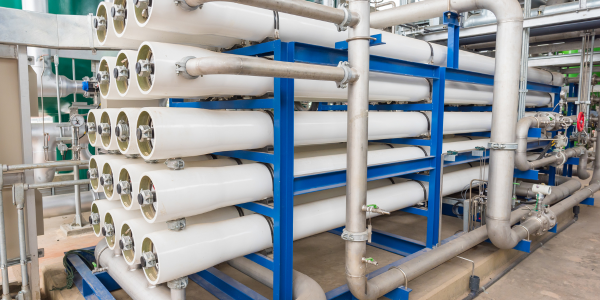
In the wastewater recycling process, the choice of the filtration system plays a paramount role in maintaining the resultant water quality and ensuring sustainability in the environment. Nanofiltration and Reverse Osmosis are two widespread technologies that are used for water filtration in wastewater treatment systems. Both of these technologies offer various advantages and have applications curated for specific water treatment needs. Leveraging nanofiltration and reverse osmosis in wastewater treatment gives you tremendous benefits in getting high-quality water. Let’s understand in detail.
In the reverse osmosis technology, high pressure is used to force water through a reverse osmosis membrane to yield pure water. A high-pressure pump is used in the process, which applies pressure higher than osmotic pressure on the water (generally about 4 MPa). The pre-treated water has to pass through the semi-permeable membrane in the opposite direction of natural osmosis.
The size of the pores in the reverse osmosis membrane is quite small, with an accuracy of up to 0.0001 microns. Thus, reverse osmosis technology can remove 99% of impurities like dissolved salts, heavy metals, microorganisms, suspended articles, and other impurities from water. The selective permeability of the semi-permeable membrane used in reverse osmosis allows only water molecules to pass through. The impurities present in the wastewater get trapped on the other side of the membrane and are highly concentrated in wastewater. You get high-quality water on the other side.
The working procedure of nanofiltration is quite similar to that of the RO system, in which external pressure is required, along with the use of semi-permeable membranes for selective permeation. The system leverages the charge adsorption and selective permeation characteristics of nanofiltration membranes for pollutant removal. The filtration accuracy of nanofiltration membranes is 0.001 microns, and the pressure required for this process is lower than that of the RO process. It usually lies between 0.5 and 2.5 MPa.
Nanofiltration technology can remove some of the substances that reverse osmosis can remove. However, the difference is that a small amount of divalent ions (such as calcium and magnesium) and monovalent ions (such as sodium and potassium) will pass through the semi-permeable membrane along with the water molecules. Thus, the nanofiltration-treated water contains some traces of elements and minerals.
Nanofiltration is highly used in water-softening applications. It is highly efficient in removing salts of calcium, magnesium, and other hardness ions to improve water quality for industrial as well as domestic use.
In the wastewater treatment process in municipal treatment, nanofiltration is mostly used for the removal of color, odor, and taste-causing compounds, improving the aesthetic quality of the water.
It is essential for treating industrial wastewater and secondary effluent so that they can be used again in non-potable applications such as cooling water, industrial operations, and irrigation.
Because NF membranes can remove particular ions selectively, they are useful for regulating water quality and process efficiency in sectors including electronics, food & beverage, and pharmaceuticals.
Despite their striking similarities, RO and NF can be differentiated by the size of the particles they can remove. Hardness, nitrates, sulfates, total dissolved solids (TDS), heavy metals, radionuclides, and organic macromolecules can all be eliminated from process and waste streams using RO and NF. These technologies can remove finer contaminants than microfiltration and ultrafiltration.
In terms of pore size, RO is the finest of all membrane systems. Its extremely small pores are capable of removing particles as small as 0.1nm. On the other side, nanofiltration is slightly coarser filtration than RO, and it can remove particles as small as 0.002 to 0.005 μm in diameter.
Our experts have vast experience in custom designing and installing reverse osmosis and nanofiltration systems for industrial wastewater treatment systems. We provide tailored solutions for wastewater treatment plants.
We pride ourselves in delivering cutting-edge technologies and unparalleled expertise to optimize your water treatment processes. Let us know your requirements.